How to deal with indecisive clients- for interior designers
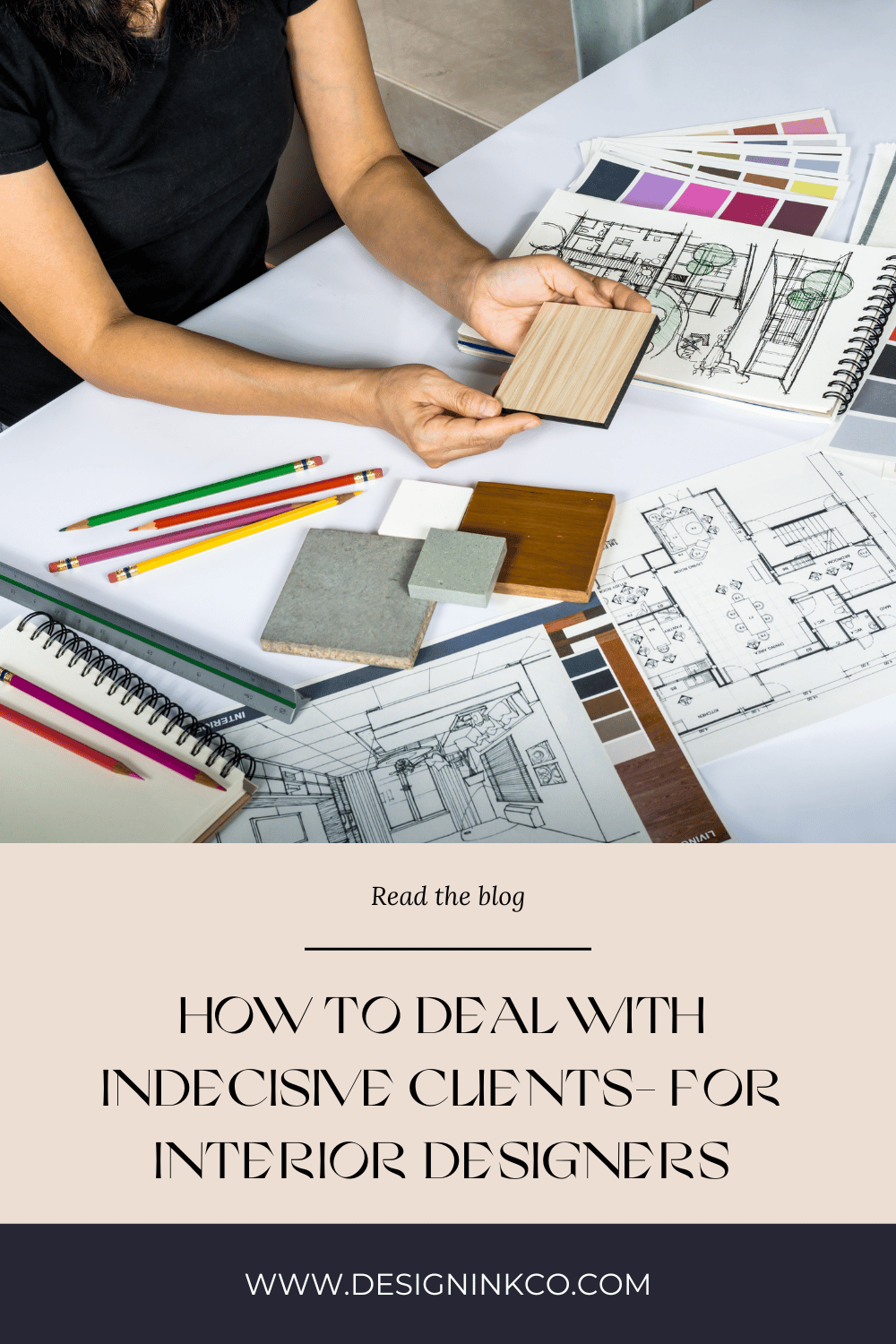
Dealing with indecisive clients can be a challenging aspect of working as an interior designer. I have had a few projects where the clients have lost sight of their original brief and got distracted by a new shiny object. They may have reached a point of saturation and overwhelm. My main strategy to deal with this difficult situation is to set out a list of goals for the space at the very beginning of the project and allow the client to recalibrate at each stage of the process. However this may not always work.
Here are a few strategies you can use to help manage indecisive clients:
1. Have a clear process that offers guidance and suggestions at each level of the design process:
Indecisive clients may benefit from guidance and suggestions from the designer. Try to understand their needs and preferences, and provide them with options and recommendations based on your expertise. This could take the form of checklists/questionnaires for each room in their project. Let them commit to paper (or digitally) their ideas. Dig deep here. Ensure that they have explored the outcome of the whole project and get them to list their priorities. It’s also a good idea to talk through a list of scenarios. I like doing this especially when we are discussing it in an abstract way. You can remind them of the discussion that you had when it gets real and you are faced with a similar problem in real life.
When you feel that the client is off track, lead them back to these notes and images and get them to evaluate if this aligns with their original thoughts. If they have changed their minds, get them to express why.
2. Use visuals :
Sometimes it can be helpful to use visual aids, such as mood boards or 3D renderings, to help clients visualize different design options and make decisions. This is why it can be extremely useful to use a tool like SketchUp, that can help you visualise your design. I also like to take them on tours ( if possible to different locations so that they can see a space in real life.
If you are able, it might be helpful to create renders of the spaces so that they can see the design realised. You could send your plans to a rendering company if you need some help.
In Melbourne, there is a company called Big Plans which allows you to project a 3d plan onto a floor so you can really see a space in real life. I have never actually used it but can see how it could be extremely useful if a client is really unsure about a space and how it might work.
Be sparing in the number of options that you present your clients, especially if you get the sense that a client is overwhelmed already. I usually present my clients with one design- usually in the discovery process we have nailed an overall vibe so more is unnecessary. I do have a few other furniture and accessory options to present if necessary, usually based on budget.
3. Set clear boundaries and expectations:
In Influencer: The Power to Change Anything, author Kerry Patterson states setting clear goals and expectations is one of the most effective ways of changing behaviour.
It's important to set clear boundaries and expectations with your clients, including deadlines for making decisions and the impact of delays on the project timeline. I have seen prices of materials rise on my interior design projects by at least 25% if not more. This has led to some revisions on material choices because of budget. We recently chose a SubZero fridge for a project, but had to abandon it because the most optimistic lead time was 1 year. I love my SubZero, but if I had to choose now I am not sure I would wait a year. This all can be extremely frustrating to clients but they have to be realistic and it’s your job to manage this!
Another way of making sure that your project stays on track is to ensure that you have a watertight Client Agreement. You should definitely get legal advice to help you prepare this. From the very beginning of your project, make sure that you set out the number of revisions and revision time that is included in your Design Proposal/Client Agreement- and stick to it!
4. Communicate regularly:
There is nothing more frustrating than hearing nothing. Sometimes, if they don’t hear from you for some time, they may feel neglected instead of nurtured. Every week send each client a Weekly Update and make sure that they know what is going right (or wrong!). You can include links to content you created or your instagram where they can see other projects that you are working on. Maintain their sense of excitement over the span of a project. Regular communication can help keep the project moving forward and ensure that both you and your client are on the same page. I have a list of around 65 emails that I use regularly throughout the client process that are used to keep the project on track. I will soon be releasing them in a bundle so be sure that you have signed up to my email list to ensure that find out when they are live.
5. Respect their decision-making process:
Remember that your clients are the ultimate decision-makers, and it's important to respect their decision-making process, even if it takes longer than you would like. However, by setting expectations you can temper the time lags. It is perfectly okay to outline in your Welcome pack how long you should expect a response and how you would like feedback. You can create videos explaining how you would like the feedback process to work and give them examples of great feedback that you can use to push that project. Sometimes, clients don’t want to be pushed and you need to decide how much guidance to give. It’s their space and as long as you are getting paid for the work that you do ( ie a retainer) you needn’t be worried. The last thing you need is to get your client offside by overwhelming them or feeding their uncertainty. In the book,"The Power of Communication: Skills to Build Trust, Inspire Loyalty, and Lead Effectively" by Helio Fred Garcia, the author advices that an empathetic approach is something that is paramount to a good relationship and help clients make a decision.
However, you may have the a client that is not going to be easily satisfied. I once completed a design consultation with my design assistant at a client’s home where she proceeded to tell us she has never had a great relationship with any designer she has ever worked with. She told us that she often sent items back to designers because they were not what she expected, even though she had seen them in a showroom. After two hours of this, my assistant told me if I took this project on, she would have to resign. I felt like resigning too! It was clear that no matter what we did, it would never be good enough. Unfortunately, a designer also has be prepared to walk away from a project if it is not working out or it’s not in the best interest of them or their client.
6. Create trust through your process and ethics:
Some designers think it is unethical to not pass on discounts to clients. This can be a matter for intense debate but essentially, as long as you are upfront with both the client prior to the signing of the Client Agreement there is nothing wrong with it if this is part of your business model.
In fact, if you have ever worked in the US, you would know that this is an essential part of the designer business model and contributes to the business’ profitability. In fact, most of my colleagues that have purchasing as part of their service, says this is the part that is the most profitable. They work with trusted suppliers and companies such as Wayfair, attend many markets around the country, building relationships and connections over years. This takes time and money.
So, essentially, as long as there is full disclosure before the Client agreement, where the client can choose to engage with the designer or not, it is your choice if you want to charge for this service.
I can do both, depending on the project. In Hong Kong, as I ran a design store, I would purchase items on my clients behalf and charge them a discount on the retail rate , depending on the size of the order. Every year, I would travel to Paris to visit Maison et Objet and buy for my clients as well as the store. I attended the antiques markets in Paris and in the country.
I would order not only my own brands (I couldn’t sell everything!) but from other suppliers as well. In fact, these suppliers were my colleagues and friends! Ultimately, the client trusted me to use my extensive knowledge of brands and suppliers & logistics to get them the absolutely best result. I dealt with logistics and delivery and purchased from around the world. I had trusted shippers based in Paris that I spent a long time working with and creating a relationship. There was risk involved but I got paid to manage this risk and give my clients excellent service and great customer experience.
Essentially, ordering products, dealing with purchasing, delivery, duties and taxes and deficiencies is one of the least fun & most stressful parts of interior design. It takes time, it is work with a capital W, and if you want to make money as an interior designer you need to charge for it. I’m going to talk through a few options in blog post on procurement and purchasing if you want to explore different models of charges.
By following these strategies, you can help manage indecisive clients and keep your interior design projects on track. It's also important to be patient and understanding, as indecisiveness can often be a result of clients feeling overwhelmed or uncertain.

Hi 👋🏽 I’m Joanne!
I’m an interior designer, educator and business coach. After studying Economics and Education at uni, the design world beckoned, drawing me to Christie’s in London, where I completed post-grad studies in art & design and then to Hong Kong, where I founded Eclectic Cool, a design firm and design store. . Eclectic Cool represented international brands such as Gubi, &tradition, HAY, Armadillo Rugs & Dinosaur Designs to name a few. My work and store have been featured in Monocle, Conde Nast Traveller, Elle Decor, Expat Living, Cathay Pacific inflight magazines, South China Morning Post and the ABC (Australia) network and more. I live on the south coast of Australia on a country property between the beautiful Australian bush and the Pacific Ocean with my husband and cavoodle. I’m the mum of three adult children.